---
title: Harpies
description: Malevolent mythological beings from the Greek tradition.
author:
name: Graciela Paula Caldeiro
url: http://graciela-caldeiro.idoneos.com
canonical: https://mitosyleyendas.idoneos.com/en/bestiario_mitologico/arpias/
source: en/bestiario_mitologico/arpias/index.md
---
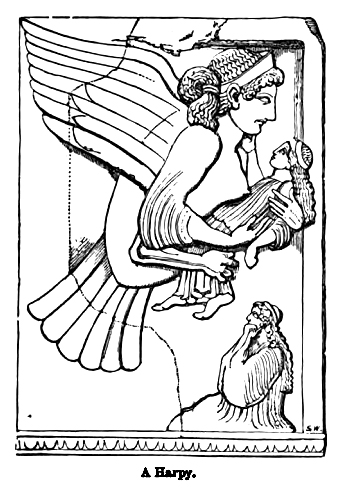
Harpy, in A Smaller Classical Mythology, by William Smith (1882), p. 233. Engraver unidentified. Source: Wikimedia Commons. Public domain.
Harpy
Harpies, or harpyiai, were female beings of Greek mythology. Literally, the name Harpy can be translated as "those who snatch away." Malevolent in nature, they personified the force of the elements, ferociously devouring everything in their path. They shrieked terrifyingly, turning all things into excrement. Some authors regarded them as demons.
They were depicted in various ways, but always following a similar pattern: a combination of woman and bird.
In his Theogony, Hesiod portrays them as winged deities with long, flowing hair, swifter than the wind and birds. For Virgil, they were birds with the faces of women, curved talons, and a foul belly.