Source: Wikimedia Commons. Public domain.
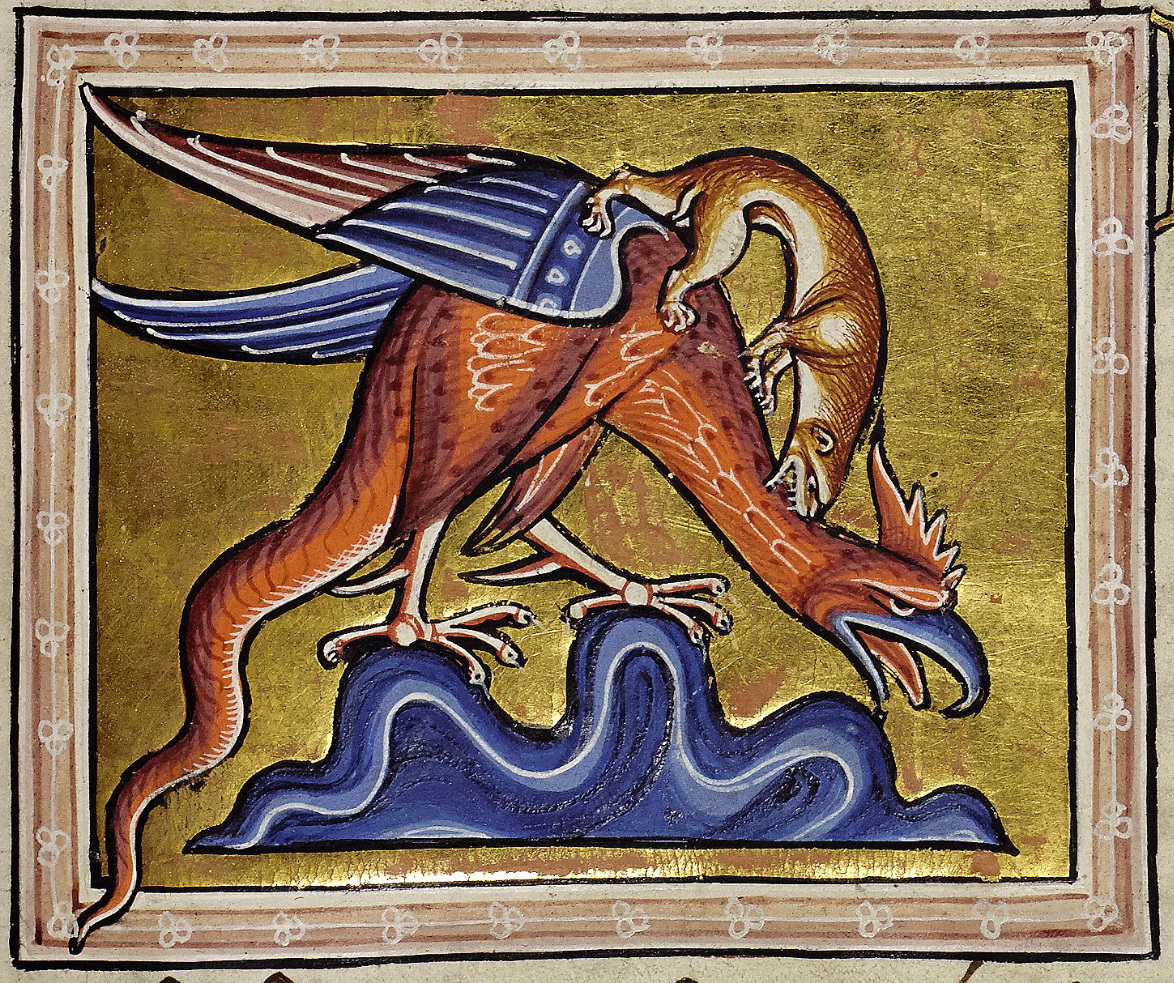
This fabulous beast may take the form of a cockerel-reptile or the form of a serpent. It is considered an elemental creature of fire and since remote antiquity has been associated with horror and ugliness.
The term basilisk comes from the Greek basilikos, which is the diminutive of basileus (king).
Pliny, in his Natural History, describes it as a beast no more than twelve inches long with white markings on its head that resemble diadems. It differs from other serpents in that it moves forward with its head raised. Its breath, just as its claws, burns the grass in its path, as well as shrubs and even rocks. It possesses a venom so deadly that if a man, even while mounted on his horse, were struck by it, he would die immediately, as would the horse. Only the weasel can kill the basilisk: the beast, upon falling into its den, dies from the very stench, though killing the weasel at the same time.
Isidore of Seville describes it as an animal about six inches long, speckled with white markings. It can kill men by the mere stench it gives off, or even with a glance. It inhabits dry places, which is why its bite causes hydrophobia in the victim.
When the myth of the basilisk was carried to the Americas, it was claimed that the beast hatches from a "yolkless" egg laid by a cockerel that has reached about seven years of age.
In Chile, the Basilisk is regarded as a small cockerel-reptile with a red crest, born from an egg laid by an old rooster or a hen that, upon laying it, "crowed like a rooster." If the egg is not burned on the spot, along with the rooster or hen that produced it, the following day a red worm is born that burrows into the floor of the house and emerges at night to put its inhabitants to sleep in order to consume their breath and phlegm. Over time, the inhabitants of a house in which a basilisk has taken up residence wither away or die of tuberculosis. When there is a nursing mother in the house, the beast suckles the milk from the mother while she sleeps, keeping the infant occupied by offering it its tail as a pacifier. In other regions of Chile, the basilisk is regarded as a lizard that sucks the blood of people while they sleep.