---
title: Abelard and Héloïse
description: A story of medieval lovers and an impossible love.
author:
name: Graciela Paula Caldeiro
url: http://graciela-caldeiro.idoneos.com
canonical: https://mitosyleyendas.idoneos.com/en/mitologia_medieval/abelardo_y_eloisa/
source: en/mitologia_medieval/abelardo_y_eloisa/index.md
---
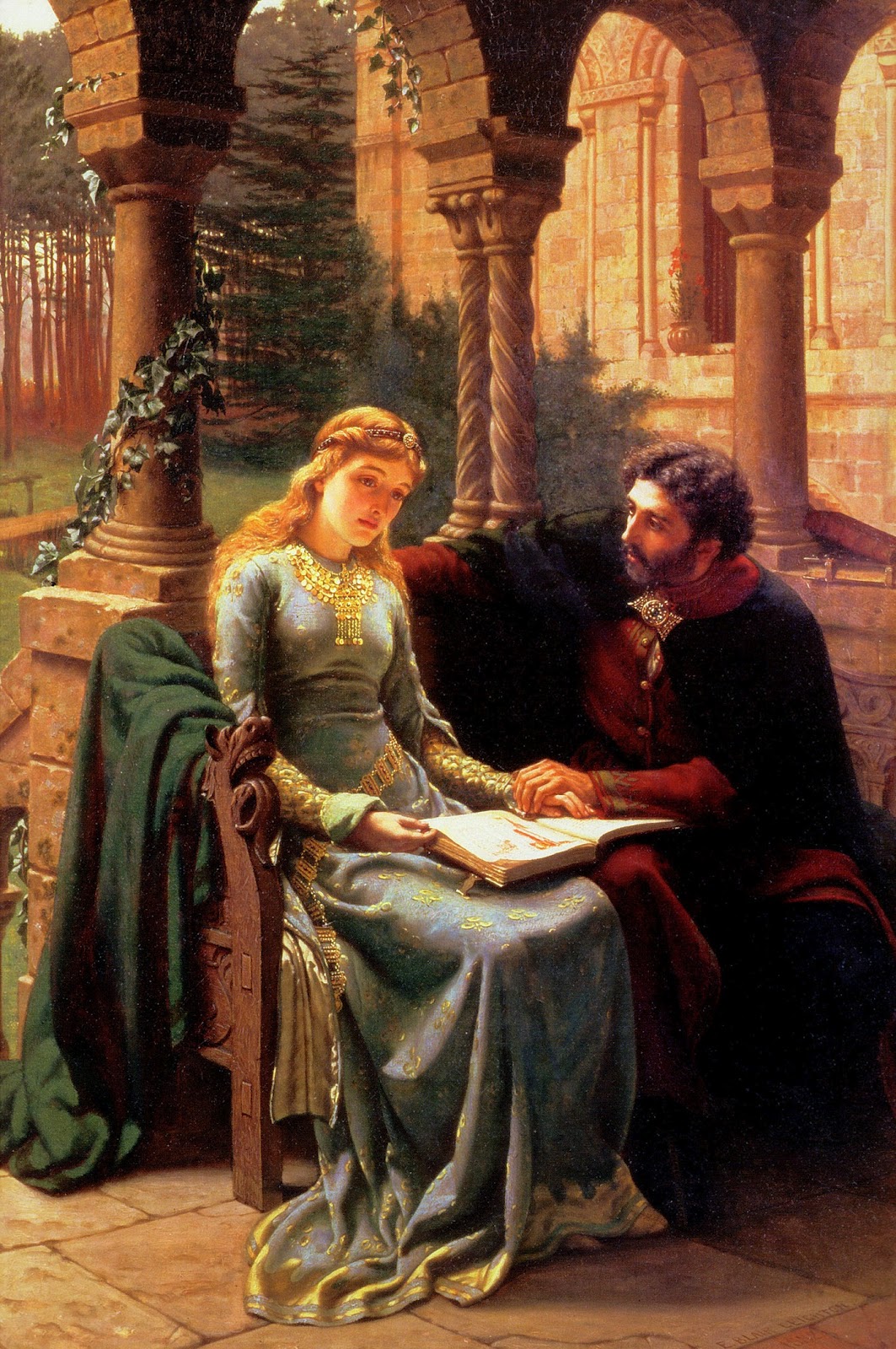
Abelard and his student Héloïse, Edmund Blair Leighton (1882). Source: Wikimedia Commons. Public domain.
Abelard and Héloïse
Abelard was born in 1079 in Le Pallet, Upper Brittany, a village near Nantes. His father, Berengar, was a cultured and distinguished man who took it upon himself to oversee the education of his son and his brothers.
While still very young, Abelard was destined for a military career, which he later abandoned out of his passion for learning. He cultivated all the branches of knowledge of his time, including music and song. And it was for the sake of study that he renounced both his inheritance and his birthright. Abelard, intelligent and tolerant, was paradoxically ascetic or sensual, depending on the shifting currents of his heart.
At the age of 20, Abelard left for Paris, devoting himself to philosophy. He established a school on the hill of Saint Geneviève and drew to it a great multitude of students, from whom he earned deep respect. Years later, his works _De trinitate_ and his _Introduction to Theology_ would stir great controversy and be condemned by the Roman Church.
He had his first school at Melun and at Corbeil, before returning to Paris at the age of 25, where he threw himself fully into philosophical debate. Abelard became a disciple of Anselm in order to study theology. He then began to dispute with his master, whom he defeated in a public debate, thereby winning over all of his disciples. Abelard's pride was awakened as a consequence of his steadfast dedication to study and his rhetorical skill.
Héloïse was a beautiful young woman of exceptional talent, the niece of Fulbert, a canon of Paris. She had been born in 1101 and was then 17 years old. Abelard, who was living in Fulbert's house, seduced Héloïse under the pretext of furthering her philosophical education: _"inflamed with love, I sought an opportunity to draw near to Héloïse, and accordingly I laid my plan,"_ Abelard wrote in a letter addressed to one of his friends.
When Héloïse became pregnant, Abelard decided to abduct her and take her to Brittany. There, she gave birth to a son in the home of his lover's sister. But when Abelard returned to Paris, Fulbert was waiting to exact his revenge: his agents would mutilate the seducer of his niece without further ado.
Héloïse, left with no other choice, would take the veil at the convent of Argenteuil, and Abelard would enter the monastery of Saint-Denis. Though the latter would later leave the cloister to devote himself once again to teaching and philosophical debate, increasing his fame and with it the number of both his followers and his adversaries.
Abelard, as a result of his ideas and theological disputes, was rejected by the monks of Saint-Denis, and so he withdrew to the diocese of Troyes, where he committed himself to an austere and rigorous life. There he founded the oratory of the Paraclete, or Holy Spirit the Comforter, of which Héloïse would later become abbess.
During the Council of Sens in 1140, Saint Bernard defeated Abelard in a public debate. As a consequence, Abelard was condemned to perpetual imprisonment (a sentence that was later commuted to confinement in a monastery). Nevertheless, some years afterward, the Abbot of Cluny, Peter the Venerable, succeeded in reconciling Bernard and Abelard.
Abelard died at the abbey of Saint-Marcel, in Chalon-sur-Saône, on 21 April 1142. He was then 63 years old. In his final years he had abandoned his heretical ideas, rejecting Arianism and Sabellianism. Héloïse claimed his body.
Héloïse died in 1163, but it was not until 1808 that the remains of both lovers were placed together in the Museum of French Monuments in Paris. Finally, in 1817, both were laid in a single tomb in the Père Lachaise cemetery in the same city. Strictly speaking, archaeologists question the authenticity of the remains. But in the realm of legend, fiction and reality are woven together into an article of faith, which is valuable simply for the romanticism of the story that those who hear it wish to believe.. Abelard and Héloïse, though the one was devoted to philosophical debate and the other to monastic life, never ceased to love each other passionately, each thinking of nothing but the other. They could not die together, but they were the protagonists of the terrible misfortune of an **impossible love** which, while it did not grant them the happiness of living near one another, did grant them the happiness of having known themselves to be loved.