---
title: Medieval Mythology
description: Myths and legends of the Middle Ages.
author:
name: Graciela Paula Caldeiro
url: http://graciela-caldeiro.idoneos.com
canonical: https://mitosyleyendas.idoneos.com/en/mitologia_medieval/
source: en/mitologia_medieval/index.md
---
Medieval myths and legends
The **Middle Ages** is considered to be the period of time spanning from the thirteenth to the fourteenth century of the Christian era. Like every historical period, it had moments of splendor and moments of darkness. Numerous legends arose during this time, populated with popular beliefs and devotions, but troubadours, minstrels and poets also flourished, along the sinuous boundary traced between love and art.
**Knight-Errantry**, the unambiguous symbol of medieval times, idealized by its most representative legends, the [saga of King Arthur](https://mitologiacelta.idoneos.com/297445), reached its height during the Middle Ages. These stories and many others were so widely popular that they were parodied by Miguel de Cervantes in the crowning work of the Castilian language, Don Quixote of La Mancha. The Middle Ages were also the stage upon which numerous military religious orders were founded, orders that more than once attained mythical dimensions. War was, strictly speaking, the most representative reality of these times.
In short, the Middle Ages were a complex universe, in which the fantastic was often taken for real and superstition constructed a religion of its own. Many of the medieval legends survive even today in the Western popular imagination, filling our traditions with castles, princesses and brave knights.
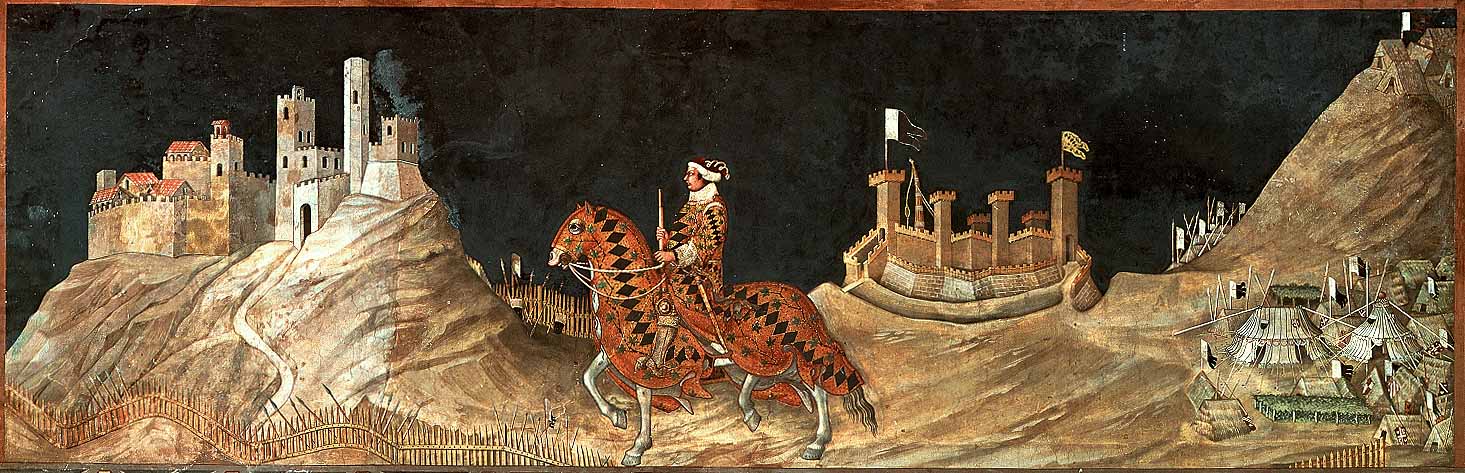
Guidoriccio da Fogliano at the Siege of Montemassi, fresco attributed to Simone Martini. Palazzo Pubblico, Siena. Source: Wikimedia Commons. Public domain.