---
title: Lohengrin
description: The legend of the swan knight.
author:
name: Graciela Paula Caldeiro
url: http://graciela-caldeiro.idoneos.com
canonical: https://mitosyleyendas.idoneos.com/en/mitologia_medieval/lohengrin/
source: en/mitologia_medieval/lohengrin/index.md
---
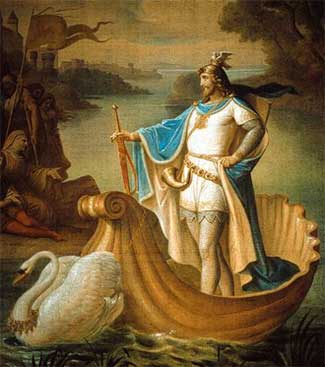
Lohengrin, attributed to August von Heckel. Depiction of the swan knight. Source: Wikimedia Commons. Public domain.
Lohengrin
**Lohengrin**, **the swan knight**, is a hero of medieval European myth who would be absorbed [into Arthurian legend](https://mitologiacelta.idoneos.com/297445) as the son of Parsifal (Perceval), the knight of the Grail.
As recounted in a thirteenth-century epic poem and other sources related to it, upon the death of the Duke of Brabant, he asked his only daughter, Elsa, to marry one of his knights, Friedrich von Telramund.
However, Elsa refuses Friedrich. Indignant, he complains to the Emperor, Henry the Fowler, that Elsa has broken her promise, and then further accuses her of having killed her father. Faced with this unjust accusation and with no one to defend her, Elsa prays for help. The prayer causes the bell of Montsalvat, in the kingdom of the Grail, to ring, signalling that someone is in danger. Lohengrin, a knight of the Grail, then goes to her rescue with the aid of a magical swan.
Lohengrin defeats Friedrich in single combat, thereby proving Elsa's innocence. Abiding by the rules of chivalric courtesy, he does not kill him, though the emperor later sentences Friedrich to death.
Lohengrin then marries Elsa, becoming the Duke of Brabant. The condition was very clear: she must never ask his name or where he comes from. The Grail itself had decreed that whenever one of its knights left the kingdom of the Grail, they must do so in absolute anonymity, such that if their identity were revealed they would be irrevocably obliged to return.
Several years later, after having had a number of children, Elsa can no longer bear her curiosity. In the original account, it is the mockery of the Duchess of Cleves that emboldens her to break the pact (in Wagner's opera it is done through the insistence of Ortrud, Friedrich's wife). At last, Elsa asks the forbidden question. Lohengrin must therefore return to protect the Grail, leaving his lady alone, with only his sword, his horn, and his ring as the sole inheritance for their children.