---
title: Myths for Reflection
description: Educational resources that propose mythical narratives as material
to promote reflection on moral, psychological and social themes.
author:
name: Graciela Paula Caldeiro
url: http://graciela-caldeiro.idoneos.com
canonical: https://mitosyleyendas.idoneos.com/en/mitos_para_reflexionar/
source: en/mitos_para_reflexionar/index.md
---
Myths for Reflection
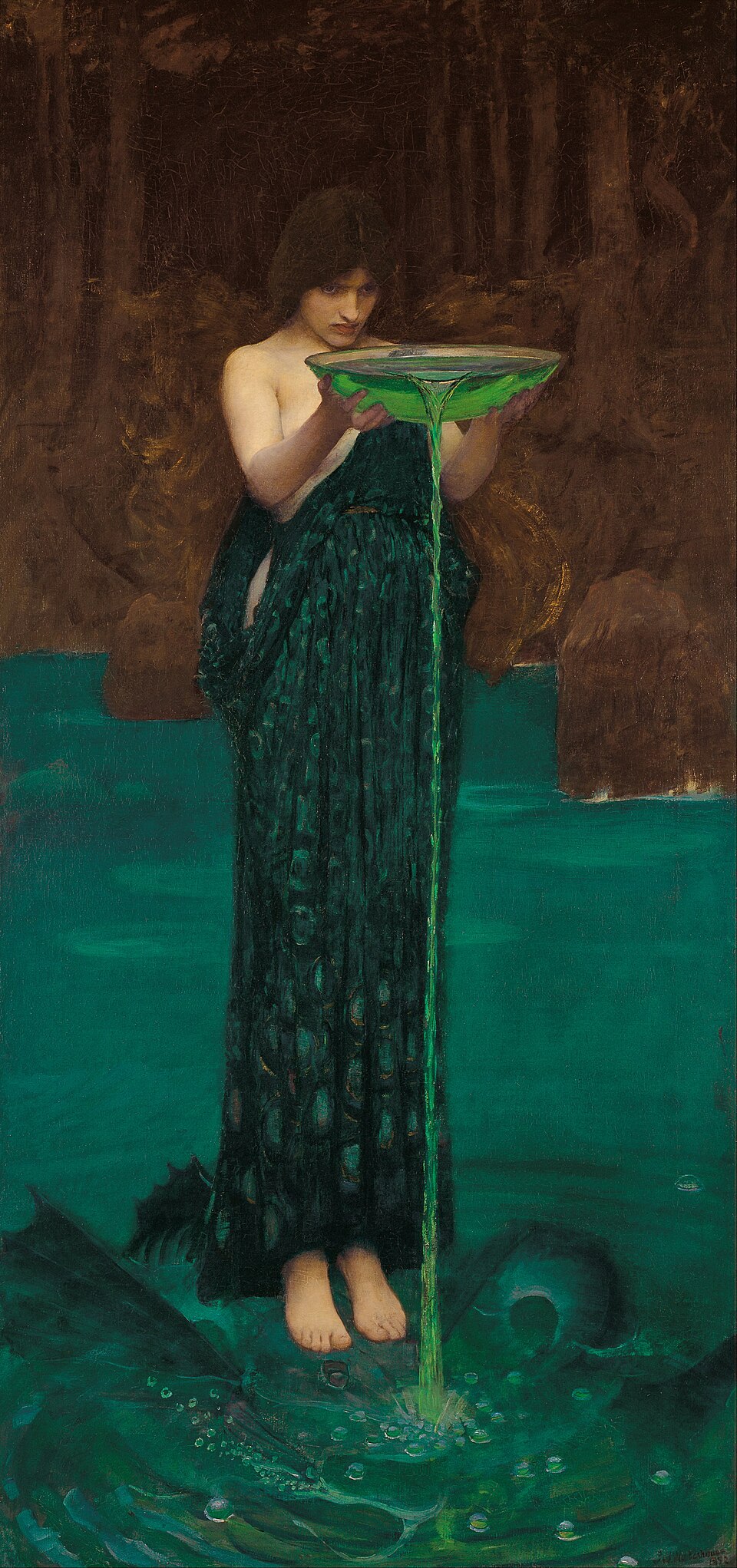
Circe Invidiosa, John William Waterhouse (1892). Source: Wikimedia Commons. Public domain.
Why **reflect** on mythology today? What meaning do these fantastical stories of gods, ancient legends, and curious tales overflowing with extraordinary feats hold for us? Beyond their literary, aesthetic or even recreational value, mythology is a symbolic tool whose interpretation and meaning can take on an unsuspected relevance.
The ambiguity of mythic discourse, unlike that of the fable, proposes an allegorical reading that is far more difficult to objectify. Yet this apparent difficulty of interpretation is simultaneously a great opportunity when it comes to proposing a moment of reflection.
Mythology thus calls upon the imagination, but it does not do so gratuitously. It explores archetypal emotions and conflicts that return to us, again and again. That is why they continue to be compelling. The currency of the mythic is inscribed in its very form.
Mythological stories can be used as **educational resources** that will allow us to address aspects such as **values education**, **self-knowledge** and **interpersonal relationships**, fostering climates of **reflection** in the most diverse settings. For it is precisely the flexibility and universality of mythic meaning that makes possible a very broad range of application.
Inspired by this idea, the following are some of our motivating proposals:
Difficulties
[The Legend of the Minotaur](https://mitologiagrecorromana.idoneos.com/la_leyenda_del_minotauro/reflexionando_sobre_la_leyenda_del_minotauro)
Personal Identity
[The Legend of Lohengrin](/en/mitologia_medieval/lohengrin/reflexionando_sobre_la_leyenda_de_lohengrin/)
Insecurity
[The Legend of Orpheus and Eurydice](https://mitologiagrecorromana.idoneos.com/297433/reflexionando_sobre_la_leyenda_de_orfeo_y_euridice)
Lies
[The Legend of the Fairy Melusine](/en/mitologia_medieval/el_hada_melusine/reflexiones_sobre_la_leyenda_del_hada_melusine/)
Foolishness
[The Myth of Cassandra](https://mitologiagrecorromana.idoneos.com/casandra/reflexionando_sobre_el_mito_de_casandra#editar)
Optimism
[The Myth of the Phoenix](/en/bestiario_mitologico/ave_fenix/reflexionando_sobre_el_mito_del_ave_fenix/)
Vanity
[The Myth of Echo and Narcissus](https://mitologiagrecorromana.idoneos.com/320714/reflexiones_sobre_la_leyenda_de_eco_y_narciso)