Christianity and Mythology
The first Christian thinkers took the word “myth” in the sense it had acquired within the Greco-Roman world as “fable, fiction, lie”; consequently, they did not subscribe to the possibility of seeing in the person of Jesus a mythical figure, nor of regarding the Christological drama as a “myth.”
From the second century onward, Christian theology seems to have concentrated on defending the historicity of Jesus against other thinkers who called it into question. Indeed, the problem of the historicity of Jesus is no minor matter, since its principal foundation consists of literary testimonies. There are those who maintain today that nothing can be known about the life and person of Jesus, despite the fact that there is considerable certainty regarding his historical existence. This circumstance is sufficient to suggest that the Gospel narratives and other early testimonies are overlaid with mythological elements. Moreover, it is well known that Christianity rapidly assimilated Jewish and pagan symbolisms, incorporating them into its own tradition.
The significant presence of solar symbols and cultural elements of a mystery-religion structure in Christianity is so considerable that it has even encouraged some scholars to call the historicity of Jesus into doubt. These theses, rather than positing a historical figure whose biography was transformed into a myth, maintain on the contrary that the myth came first and was subsequently, and imperfectly, historicized by the earliest generations of Christians.
Historical Time and Liturgical Time
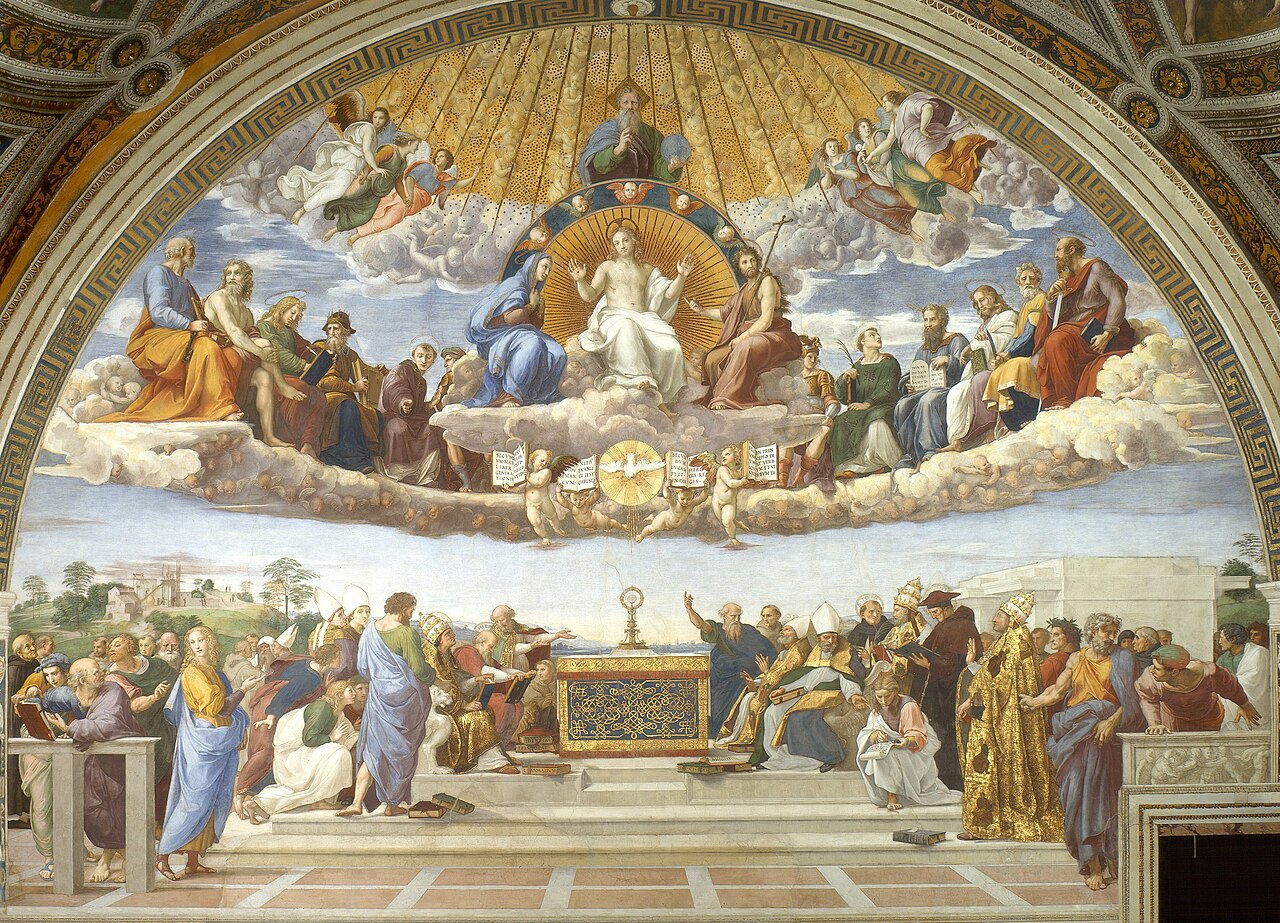
Source: Wikimedia Commons. Public domain.
“In the Most Holy Sacrament of the Eucharist there is truly, really, and substantially contained the Body and Blood of our Lord Jesus Christ, together with his Soul and Divinity. In reality, the whole Christ.” Council of Trent
The ritual of the Eucharist is, for the believer, a commemoration of the historical event of the Last Supper, in which one participates by taking part in the ritual.
According to Origen’s interpretation, the distinctive feature of Christianity lay in the fact that the Incarnation of Jesus had taken place in historical time and not in cosmic time. On the other hand, when Christianity elevates Christ to Divinity, it is reasonable to consider this an implicit declaration of transhistoricity.
It is likely that for the first Christians, the center of all religious life was provided by the drama of Jesus Christ, which, even though it had occurred at a historical moment, was what, according to the Christian creed, had made salvation possible; it was therefore necessary to ritually reiterate this exemplary drama and to imitate the model they saw in the figure of Jesus. In this sense, religious behavior is in solidarity with mythical thought.
Liturgical time is nothing other than the recovery of the time of “beginnings” (illud tempus); thus religious experience is sustained by the imitation of the model, the annual liturgical repetition (the liturgical year) of the passage of his life (the drama: birth–life–death–resurrection).
Although Christian liturgical time is a circular time, it accepts, as a faithful heir of Judaism, the linear time of history: the world was created once and for all and will have only one end. The Incarnation took place only once, and there will be only one judgment at the end of time.
Within Christianity there exist numerous elements derived from other traditions; for example, the Gnostic elements present in the Gospel of Saint John and in the Epistles of Saint Paul, as well as in certain other early writings, are preserved. Gnosticism was persecuted, but its influence was not thereby eradicated; in the Middle Ages, Gnostic myths would reappear, somewhat transformed, in written and oral literature.
Judaism, for its part, provided Christianity with an allegorical method for the interpretation of the scriptures, in addition to the model of historicization mentioned earlier, which becomes evident in the religious festivals.
Asian and Mediterranean symbols, rites, and myths were also “Christianized,” being syncretized with the sacred history that arose from the Old Testament and now incorporated the New Testament, the preaching of the apostles, and later the lives of the Saints.
There are, then, cosmic symbols present in the sacred history of Christendom: water, the tree, the vine, the plow, the ship, and so on—symbols that had already been assimilated by Judaism and that were integrated into Christianity upon receiving sacramental treatment.
Pagan Christianity
 Pagan divinities were also assimilated by the Christian religion: gods or dragon-slaying heroes were transformed into Saint Georges, storm gods were transformed into Saint Elijah, and the numerous fertility goddesses were syncretized with the Virgin or with female saints. Indeed, a large part of pre-Christian European religiosity has survived beneath the masks of Catholic divinities and the feasts of the calendar.
During the Middle Ages numerous manifestations of mythical thought appeared. All social classes attributed mythological traditions of their own to themselves. The chivalric order, the trades, the clergy, and the peasantry adopted “myths of origin” concerning their condition or vocation, in accordance with which they strove to imitate an exemplary model. It is not possible to delimit the sources of these mythologies, since they are varied. For example, in the particular case of the Arthurian saga and the theme of the Grail (see mitologiacelta), beneath a Christian mask there lie ancient Celtic beliefs, especially those connected to the Otherworld. And so the knights would seek to rival Lancelot or Parsifal, and the troubadours created a mythology of Woman and of Love, making use of Christian elements while going beyond the doctrines of the Church.