The Mythological Tradition of Islam
Source: Wikimedia Commons. Public domain.
The letter of Islam is nothing other than a continuation of the tradition that begins with Zoroastrianism and continues along the Judeo-Christian line in such a way that it claims to carry that tradition to its final formulation. The legends of the patriarchs, of the nomadic people and the desert, the golden calf, the revelation on Mount Sinai... are repeated together with their lessons throughout the Quran in the same way as other segments of strictly Christian mythology.
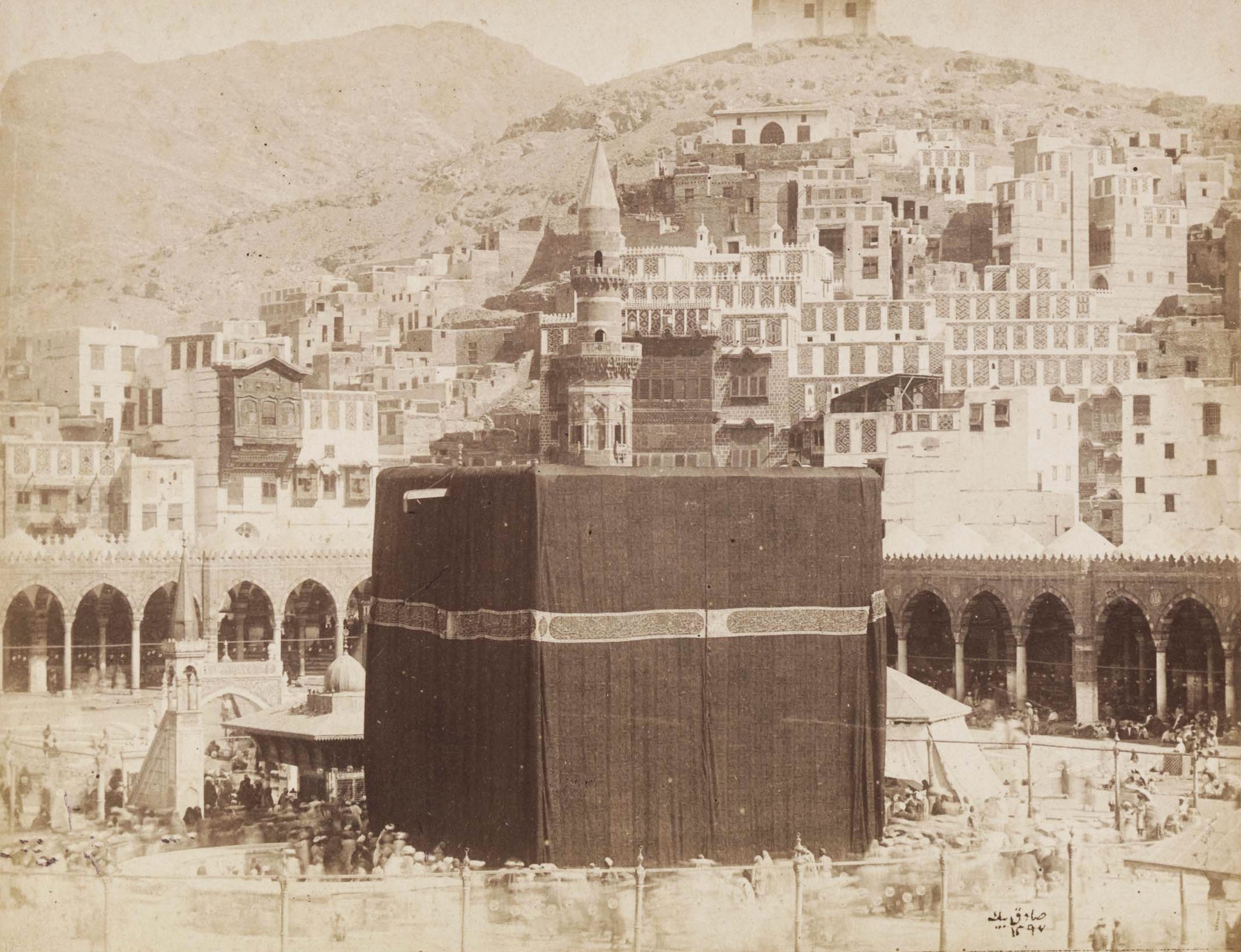
The foundational legend of the Quran concerns the descendants of Abraham, so that Muslims are brothers of the Jews. According to the Bible, Abraham had two wives: Sarah and Hagar (who was an Egyptian slave). From his union with Hagar, when Abraham was 86 years old, Ishmael was born. From his union with Sarah, when Abraham was 99, Isaac was born. The Islamic version continues the family narrative: Abraham and Ishmael built the Kaaba of the Grand Mosque of Mecca some years before the separation:
Abraham and Ishmael raised the foundations of the House with this prayer: “Lord, accept this from us. You are the All-Hearing, the All-Knowing. Oh! Lord, make us Muslims, submissive to You, and make of our descendants a Muslim community submissive to You; show us our rites of worship and relent towards us. You are truly the Relenting, the Merciful.” Quran 2:127–28
Not only Abraham and his sons, but Jacob and his as well were also Muslims. Since the Quran is a revealed book, there is no contradiction with what other religious traditions may hold. According to Islam, “the People of the Book” — that is, the Jews — closed their eyes to this revealed truth by rejecting the message of Islam. Christianity, for its part, clinging to a Trinitarian doctrine (God is one and triune), added other gods to the one God, misinterpreting Jesus (who is considered a prophet) and who must be understood within the line: Abraham–Moses–Solomon–Muhammad.
Characteristics of the Semitic Deity
Allah is a product of the same desert in which Yahweh was conceived. The name (Yahweh) was foreign to the Hebrews, and in their attempts to explain it they connected it with the word hayah (to be). In the same way, the Greeks, who did not know the exact meaning of “Zeus,” connected it with the word zav (to live), which would derive from the Indo-European dyu (to shine). The thesis of the Arabic origin of Yahweh would coincide with the historical data of the Old Testament, which links him to the Negev and to southern sanctuaries such as Sinai-Horeb and Kadesh. It is thus probable that the origin is Arabic, deriving from the root hwy (to blow). Indeed, according to this etymological hypothesis, Muhammad’s claim that the first worshippers of the biblical God were of Semitic descent does not appear to be mistaken.
As the god of the Semitic peoples of the desert, Allah is similar to Yahweh. He displays the same traits of a Semitic tribal deity: he is not immanent in nature but transcendent. This type of god cannot be known through the study of the natural order, either in its external dimension (scientific) or in its internal dimension (meditation), since such divinities are not contained by nature. Another characteristic is that for each Semitic tribe, the principal God is the protector and the provider of the law that will govern its group. The Semitic deity does not make himself known through the stars or the cosmic order, but through laws and customs that differ from group to group. For this reason, while for the Aryans — whose most important gods were identified with nature — there was a natural tendency to recognize their own divinities in other cults, with a clear inclination toward syncretism, for the Semites the tendency was always toward separatism and differentiation, since each god was exclusive to each group.
From Monolatry to Monotheism
Thus, each group has its own divine lawgiver, its patron. At this stage there is no ambition for a local god to be the lord of the entire world. This period was called monolatry, a stage in which Yahweh was merely a tribal god, perhaps more powerful than those of other peoples.
But later, through the development of the biblical tradition, the tribal god came to be identified with the creator god of the universe, though only Israel could claim to know and worship that one true God among all gods.
Paradoxically, however, this divine concept of cosmic dimensions did not emerge until the peoples of the desert came into contact with more developed cultural spheres in which writing had been a mastered technology for a long time and it was possible to maintain precise astronomical records. The cosmic order as understood by the priests of those ancient civilizations exhibited an astonishing mathematical regularity, and the ultimate foundation of these rhythms of being had not been represented as an intentional personality like that of Yahweh. In those systems, the dimensions linked to passion, personality, will, and mercy were secondary with respect to the central, absolutely impersonal order to which all other gods were in some way subordinated as mere agents. And so, in decisive contrast with this conception, the Semitic peoples of the desert maintained their own tribal conception while broadly incorporating this idea of a cosmic order. A process thus took place whereby, instead of subordinating their god to the cosmic order, they elevated him to the rank of creator and sustainer — but in no sense his immanent being. For even while incorporating this new concept, they would not renounce the personal and anthropomorphic aspects of the deity. Moreover, the tribal god would also continue to be recognized through his social laws pertaining to the favored group: and these would not be laws of nature, open to the eyes of all so that they might be thought about and analyzed, but particular laws of a specific social group, which were to be regarded as the expression of the sole teaching of God.
====
Source: Wikimedia Commons. CC BY-SA 4.0.
Up to this point we have seen the similarities between Yahweh and Allah. However, it is possible to establish differences between the two. While the god of the Old Testament is clearly tribal, in the Quran he addresses himself clearly to all of humanity. As with Buddhism and Christianity, Islam conceives of itself as a universal religion, unlike Judaism or Hinduism, which remain in practice identified with an ethnic group. Indeed, Muhammad’s vision also encompassed foreigners belonging to other peoples. In the Quran there is therefore no dominant race or tribe. Thus, that concept of the desert lawgiver-god was expanding toward a larger world.
But the laws conceived under the earlier revelation of Yahweh in the desert had been designed for an actual society, whereas from the perspective of Islam, these laws were to be derived from a series of pronouncements made in a state of trance by a single individual over the course of 23 years. In the creation of this Muslim legal order, three authorities would be recognized, the first of which was the sacred book itself: the Quran. But when the book was not explicit, Muslim jurists had to admit other sources: a marginal body of tradition called hadith (maxims). A third source would be used when the two previous ones proved insufficient: qiyas (analogies), which meant applying to a new problem the principles underlying an existing ruling on some other matter that could be considered analogous.