Greek Mythology and Religion
The Greek mind instinctively sought harmony and order in the universe, which might lead one to speculate that it would develop a monotheistic religion. On the contrary, it professed the most exuberant polytheism. Even in classical times, in the days of enlightened culture, poets seem to invent new gods with great spontaneity: Hope or Fear, or a dozen such conceptions, could become gods without much surprise. Although it was inexactly translated in the Authorized Version, Saint Paul found the Athenians “very fearful of God,” but in reality they feared a multiplicity of gods.
The background of classical poetry and art is extremely serious—not that it lacks joy and charm, but its outstanding quality is a sense of moral responsibility. Yet the myths on which it is based seem incredibly shameless. The countless stories of caprices, brutalities, and infatuations might lead one to believe that the Greeks judged their moral duties lightly. But that would not be a correct assessment. Indeed, the Greek word théos does not mean God in that sense, and moreover, the bond between ethics and theology did not exist in the way it would later be conceived by Western civilization.
Archaic Greeks seem to have thought about the gods much as any primitive society does. Our life is subject to the forces of nature that we cannot master, and these forces are theói, gods. All one can do, then, is try to remain on good terms with these powerful forces. Such powers are heterogeneous and arbitrary; the rain falls on the unjust as well as on the just. There are also other powers whose function is that of protectors: the gods of the tribe, the clan, the household. These invisible members of the social group must be treated with scrupulous respect. Sacrifices must be offered to all the gods in the prescribed manner, since any irregularity might anger them. It is not evident that they are bound by the laws that govern human conduct; indeed it is obvious that some divinities are not. The division between theology and morality is explicit.
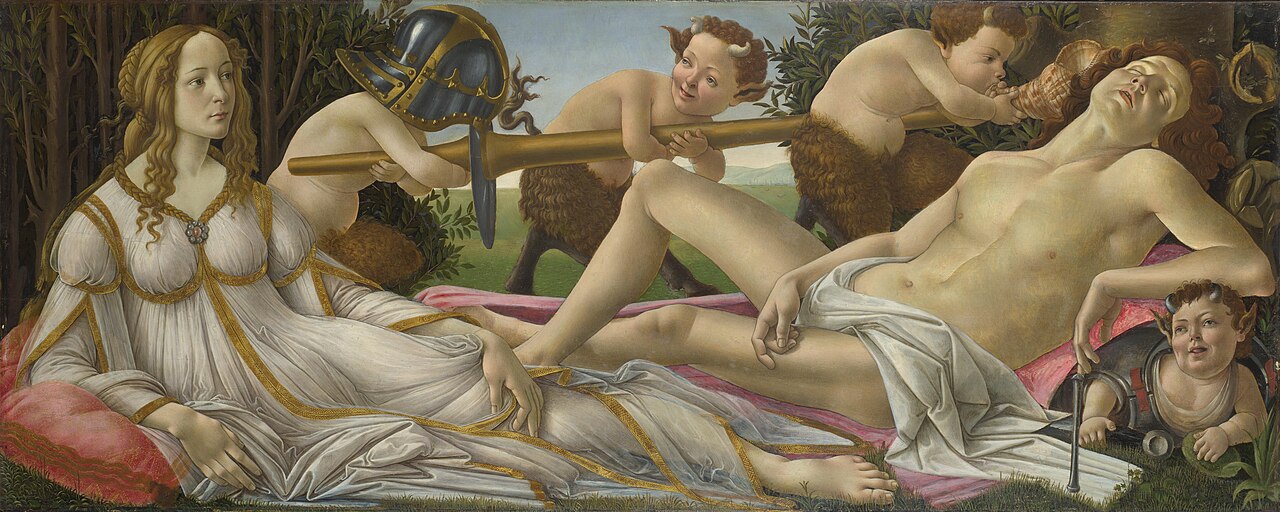
Source: Wikimedia Commons. Public domain.
The character of the Greek people is already apparent in their primitive religion. Among the Latins, the higher powers continued to be numerous and anonymous for as long as the religion lasted, and the ritual consisted in observing formulas strictly even when their meaning had been forgotten. There was a purely imagined numen, inexactly translated as “spirit,” to which all the acts of human life were attributed… and if those rites were strictly observed, nothing else mattered. But it was genuinely different among the Greeks. An aesthetic and dramatic sense led them to the need to represent the gods and their powers anthropomorphically. The gods were something like sublimated kings. Moreover, the impulse toward order and unity caused them to group these divinities into a family and a family council. Indeed, Zeus, the great tribal god, was also a celestial god. There was also a deity, Herkeios, who protected a man’s hérkos, that is, the enclosure of his farm. But these gods were unified into one, and herkeios became a simple adjective, a special aspect of Zeus in this particular function of defending the enclosure.
Although some of these “divine” powers may seem anarchic and contradictory, a regular rhythm can be observed in the universe that may be strained but never broken. There is a power superior to the gods, but the gods are not omnipotent.
Spiritualization of the Mythological System
The somber power of the gods was called anánke, “that which must be,” or Moira, “the distributing fate.” In this conception of a universal and impersonal power lies the genesis of later religious and scientific developments.
Later, at a subsequent stage, the theological begins to combine with the moral. This is not a clear and systematic process, but it is obvious that it slowly gets under way. Along these lines, one observes that sacrifice to the gods demanded a ceremonial purity: for example, a man who had shed blood could not take part in them until he had been purified. In time, this divine demand for outward purity was transferred to inward purity. Similarly, certain offenses that human law could not punish nor men perceive were placed under the sanction of divine judgment.
In primitive society, to be outside the law was equivalent to lacking all legal protection, something that poor people could not easily obtain. In this way, the stranger, the suppliant, and the beggar were beings whose care depended on the gods.
The Greeks refused in the most absolute terms to distinguish between nature in general and human nature in particular. Thus, the same forces that governed the universe had also to govern the moral universe. At this point, a clear spiritualization of the gods can be observed. Anánke or Moira are no longer merely superior to Zeus but are the expression of his will, and other divine powers, such as the Furies or Erinyes, who punish violence and injustice, are his lawful agents.
Three Classes of Greek Myths
Historical Myths
In this category are found the stories of the Trojan cycle or the fables of Perseus who cut off the head of the Gorgon. These stories are transformed over time into traditional tales comparable to modern fairy tales.
A-historical Myths
Tales such as the overthrow of Cronus and his mutilation by his son Zeus, or the enormous number of goddesses, nymphs, and mortals who were loved in succession by Apollo and Zeus. In general, this type of story had the character of offering an interpretation of things; they represented the color and movement with which the Greeks clothed the most salient features of their vital experience, and whose symbolic expression was driven by the intellect.
Myths of Origin
But yet another type of myth existed as well. Myths that were an attempt to address the origin of things, first of the physical universe and then of the gods:
In the beginning there was Chaos, the dark abyss. From Chaos arose the broad and wide earth, the true mother of all things, of gods and men. She produced Uranus (the sky), and the Earth and the Sky, uniting, produced the Night, and a race of monstrous beings, images of physical and psychological forces.
This gradual evolution from the initial confusion of chaos to order is expressed as an explanation of the world, although it implied a certain unfilial conduct on the part of the gods that would later horrify the Greeks of subsequent ages.
The a-historical tales could be understood as explanations. Certainly there were religious practices and vaguely remembered traditions that demanded some clarification, but once the truly historical facts had been forgotten, they were replaced by fiction. On the other hand, Greek polytheism was representative of Greek heterogeneity. Only highly developed religions demand exclusivity and intolerance. Polytheistic religions absorb new gods naturally. Conquered peoples continued to worship the old deities while incorporating the new ones. For example, the cult of Hyacinthus and Apollo at Amyclae, near Sparta, consisted of pouring libations on the ground. But the second day of the festivities, dedicated especially to Apollo, was much more joyful. The origin of this ancient double-cult festival probably lies in the fact that the new god Apollo was added to the ancient local tradition of Hyacinthus, an earthly and not a celestial god. But as the generations passed, the origin of this double festival was forgotten, even though the rite remained alive. Thus, pouring offerings on the ground could only mean paying homage to someone who had died, and since Apollo was present at the festival of Hyacinthus, Hyacinthus must have been dead and a great friend of Apollo. There thus arises an explanatory legend of a forgotten ritual: Hyacinthus had been a young man beloved by Apollo, whom Apollo accidentally killed while throwing a discus.
The Countless Lovers of Zeus and Apollo
At other times, the primitive deity was a goddess. In that case, the natural course was to make her the wife of the new god. If it was a god, as in the case of Hyacinthus, he might become the son of his replacement, but this required a mother—some local nymph or goddess. Thus, as more and more gods were identified with Zeus and Apollo, the countless goddesses, nymphs, or women who had been their lovers multiplied accordingly. These divine loves were by no means a religious offense, because their purpose was to provide an explanation, and they carried no dogmatic, apologetic, or moralistic import whatsoever. Indeed, what was essential was to perform the rite; nothing truly obliged anyone to believe the stories told about it.
Philosophy and Religion
Greek polytheism was a natural religion that grew more complex and diverse as the Greeks spread across new territories. One might consider that there were two different kinds of religion: one strictly linked to the social group, and the other to the worship of nature.
The Greek instinct for harmony and logic is evident in the creation of the Olympian system presided over by Zeus, the father of gods and men. In it, the Hellenic tribal and celestial gods, the apparently non-Hellenic gods and goddesses of nature, a whole host of daimones (spirits) such as the Erinyes (avengers), or personified abstractions such as Dike (Justice) or Themis (Law), were gathered together within a coherent system. This instinct is also apparent in the way in which morality, originally a matter of human and social character, is placed under the protection of the gods. The numerous myths were deliberate explanations of various facts and phenomena that the Greek imagination developed by giving them an anthropomorphic and dramatic form.
But later, when religion and morality began to find common ground, the gods ceased to be merely natural, social, and psychological powers and became moral ones as well. Myth, predominantly amoral, began to be an obstacle. A contradiction thus became apparent, which artists resolved by ignoring what displeased them and philosophers by eliminating it altogether. Thus Xenophanes would observe that if donkeys had gods, those gods would have the form of donkeys. Indeed, anthropomorphism was the soul of Greek myth. Moreover, a god could not desire anything, since if he were truly a god, he would have to be complete and perfect. Plato condemns the poets for spreading false and wicked stories about the gods. Thus, the future of Greek religious thought would no longer be found in the luxuriant mythology, nor in the gods of Olympus… it lay in philosophy. Indeed, the Greek element survives with full clarity in Christianity and derives from Plato. It was Greek philosophy, especially the Platonic conception of the absolute, that prepared the Western world for the remarkable leap toward a universal religion.