On Hierophanies and Symbols
Mircea Eliade coined the term hierophany to refer to the manifestation of the sacred as applied to various objects: a mountain, a tree, or a chalice. Eliade observed in this regard that the concept is not determined by any particular religion or culture, but that a hierophany occurs when the experience of the sacred is recognized as a reality distinct from the empirical (in the sense of "worldly"). Thus, if a stone expresses a superior and supernatural power, it reveals to man an absolute mode of being, differentiating it from the profane space surrounding it, since one of the functions of the hierophany is precisely to separate sacred objects from profane ones.
We add in this vein that mythological symbolism also has a hierophanic dimension, insofar as it can be the bearer of a sacred significance. In this way, symbols and archetypal objects merge in a single quest: the quest for the supernatural.
To compile a dictionary of mythological symbols is, without doubt, a pretentious undertaking, because strictly speaking, mythological allegory, characterized by ambiguity, does not admit of a single, unequivocal definition. Therein lies the true richness of the symbolic.
Thus it is that every symbol, even when it has been used by many traditions and its symbolism defined and revealed, always retains a personal and individual dimension that assigns to each symbol a unique meaning which each person will discover according to their own history. Therefore, this brief glossary does not aspire to establish precise definitions but merely to suggest some interpretation that the reader may judge and leave open to their own intuitions.
Tree
Respect and veneration for trees is found throughout the world. There are many traditions that speak of the tree of life. Often a tree is the central point and axis of the world, establishing a point of union between heaven and earth, for it takes root in the underworld and its branches extend toward the sky. It may be interpreted as man's struggle to attain perfection.
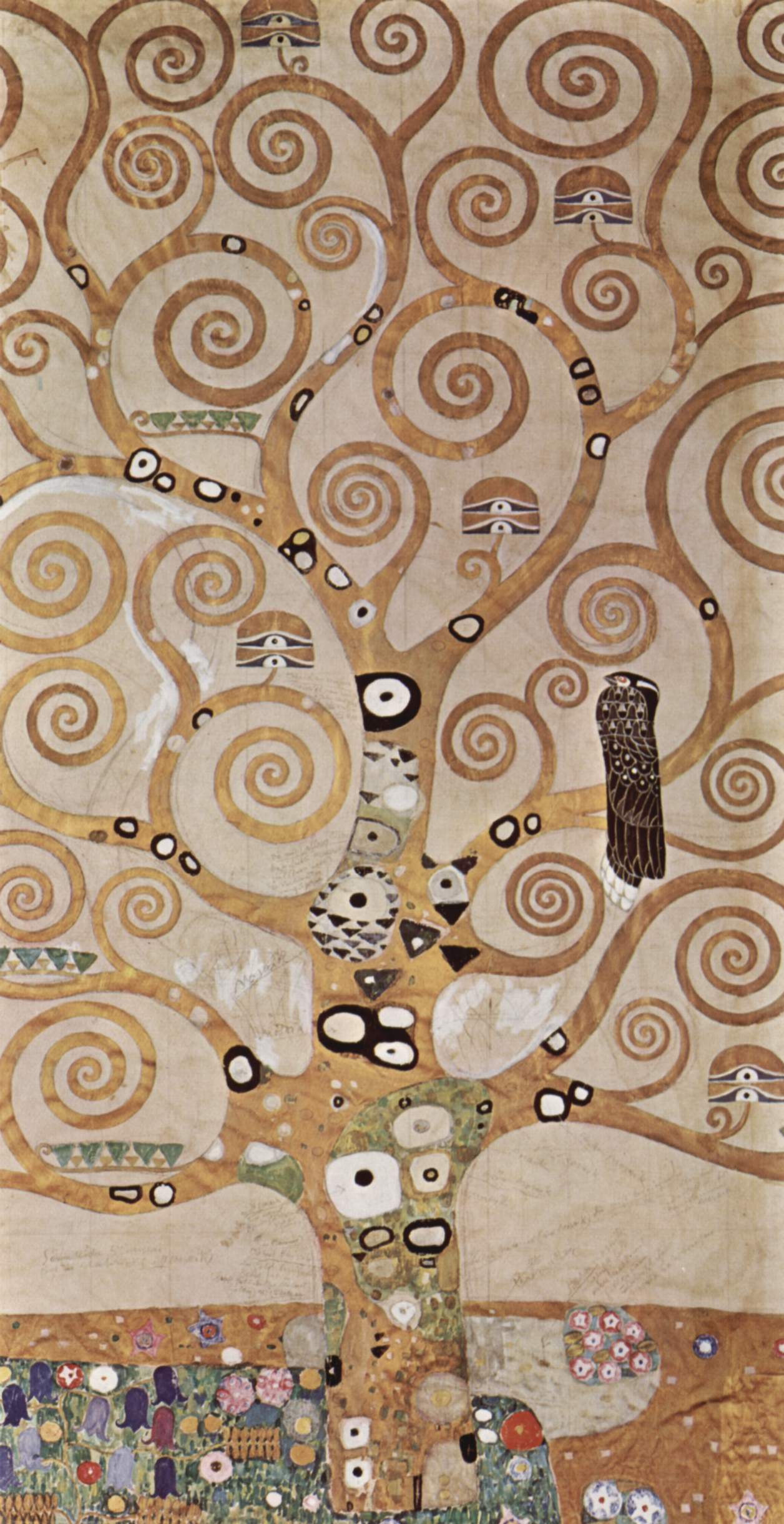
Source: Wikimedia Commons. Public domain.
Tree of Knowledge (tree of good and evil)
Symbol of temptation, it grows in paradise covered with the fruits of good and evil. When Adam yields to Eve's temptation, he defies the divine will, bringing into play the loss of innocence.
Christmas tree
Widespread throughout Europe and the Americas, it is currently a symbol of the birth of Christ. However, the custom of decorating an evergreen tree dates back to pagan times. Indeed, the association of the winter solstice with Christian festivities, characteristic of medieval syncretism, has not discarded a large part of the pre-Christian symbolic heritage.
Tree of Life
Present in many traditions, there is mention of a tree that is the central point and axis of the world. It establishes the union between heaven and earth: its roots reach down to the underworld and its branches extend toward the sky. It may perhaps be understood as man's longing to attain perfection.
Bodhi
The Bodhi is a tree similar to the fig tree and symbolizes the enlightenment of the Buddha, as enlightenment came to him while he was meditating beneath its branches.
Yggdrasill
Yggdrasil is an ash tree that in its mythological form represents the entire world. Its trunk corresponds to the central axis of the universe, and from below its roots the waters of rivers bubble up, a symbol of wisdom.
Scarab
In ancient Egypt, it was a symbol of resurrection and immortality. The scarab pushing its ball of dung, which contains its eggs and from which the young scarabs emerge, acquires the symbolic dimension of the image of the rising sun, bearer of a renewing energy. In this way, the scarab becomes a metaphor for the transformations necessary for maturation. In hieroglyphic signs, the scarab is used to write the term "kheper," which evokes the idea of birth, but also of becoming.
Star
Star of Bethlehem
The Star of Bethlehem is the star that, according to the Gospel of Saint Matthew, guided Mary and Joseph to show them the safe place where the child Jesus would be born. Strictly speaking, however, there is no scientific evidence to demonstrate its existence, and the various astronomical speculations made on the subject do not appear to coincide chronologically with the story; moreover, this star (or perhaps comet) was not recorded by Herod either. For some researchers it is simply a tradition. Thus, in the context of the Christian religion, it is understood as a good omen of hope related to the birth of Jesus.
Star of David
Central symbol of Judaism and of the State of Israel, the Star of David, with its two interlocked triangles, represents the balance of the universe. The triangles represent the sun, fire, and masculine energy; the second, the moon, water, and feminine energy.
Eden
Fire
Fire has been worshipped since prehistoric times for its power to heal wounds, provide warmth and light, and drive away predators. Since time immemorial, dancing around fire formed part of sacred rituals. It later became part of religious altars and sacrifices. It constitutes the most important theophany of Zoroastrianism, where it acquires the status of a divinity in that it must never cease to burn in the temples. In pre-Zoroastrian religion it was believed that Mithra, divine lord of fire, had set the world in motion.
In India and Iran, the ritual fires are three: that of the farmers, that of the warriors, and that of the priests. The natural fires are five: the one that resides in Ahura Mazda, in the bodies of men and animals, in plants, in the clouds, and in the earth.
Grail
The legend of the Grail is rooted in the Christian tradition, according to which there was a chalice used during the Last Supper, or perhaps another in which Joseph of Arimathea collected the blood of Christ. The legend is not based on biblical texts, and its sources seem to be lost in the fabric of time.
The invention of the Grail is attributed to Chrétien de Troyes, author of The Story of the Grail, dated to 1190, who had probably drawn inspiration from the magic cauldron that appears in the Mabinogion, written during the eleventh, twelfth, and thirteenth centuries, to create this magical object that Perceval saw in the castle of the Fisher King. Chrétien de Troyes uses the Grail to bring a holy host to the Fisher King's father, the old man's sole sustenance. Robert de Boron, in Le Roman de l'Estoire dou Graal or Joseph d'Arimathie, identifies the Grail with the chalice of the Last Supper, in which he has collected some drops of blood from the Crucifixion — accounts that can be traced to the apocryphal gospels of Nicodemus and the Acts of Pilate. The Saga of King Arthur ultimately transformed the quest for the Grail into a recurring theme of medieval literature.
More on the legend of the Grail and its sources in the Celtic tradition
Grottos
Grottos in ancient Greece were sites where sacred rites were performed. Later, Greek and Roman gardens were created as artificial caves to reinforce the magical union between the garden and nature.
Labyrinth
In Greek mythology, in the legend of the Minotaur, the labyrinth is the obstacle that Theseus must overcome in order to defeat the Minotaur.
On the other hand, the use of labyrinths in gardens began in the Renaissance. Their form creates the confusion and intimacy necessary for lovers.
It might be said that the labyrinth represents the journey from darkness to light, or the secret wisdom that is discovered after passing a test.
Magic Well
Symbol of the feminine principle, as a source of life, it possesses magical properties. Tradition holds that if a coin is thrown into a well, a wish may come true.
Magic Potion
It appears in the medieval legend of Tristan and Isolde, and its effect is to provoke an inescapable amorous passion. It is considered that it may serve as a moral justification for adultery. Read more about magic potions
Serpent
The serpent is perhaps the most venerated creature, as it embodies a great number of forces. From biblical accounts to Mesopotamian ones, it symbolizes a great number of forces. It is associated with the underworld and with the primordial waters as creators of life. In agricultural communities it may also represent fertility. And its shedding of skin represents renewal and even eternal youth, as it appears in the story of Gilgamesh.