The Allegorical Reading of Sacred Texts
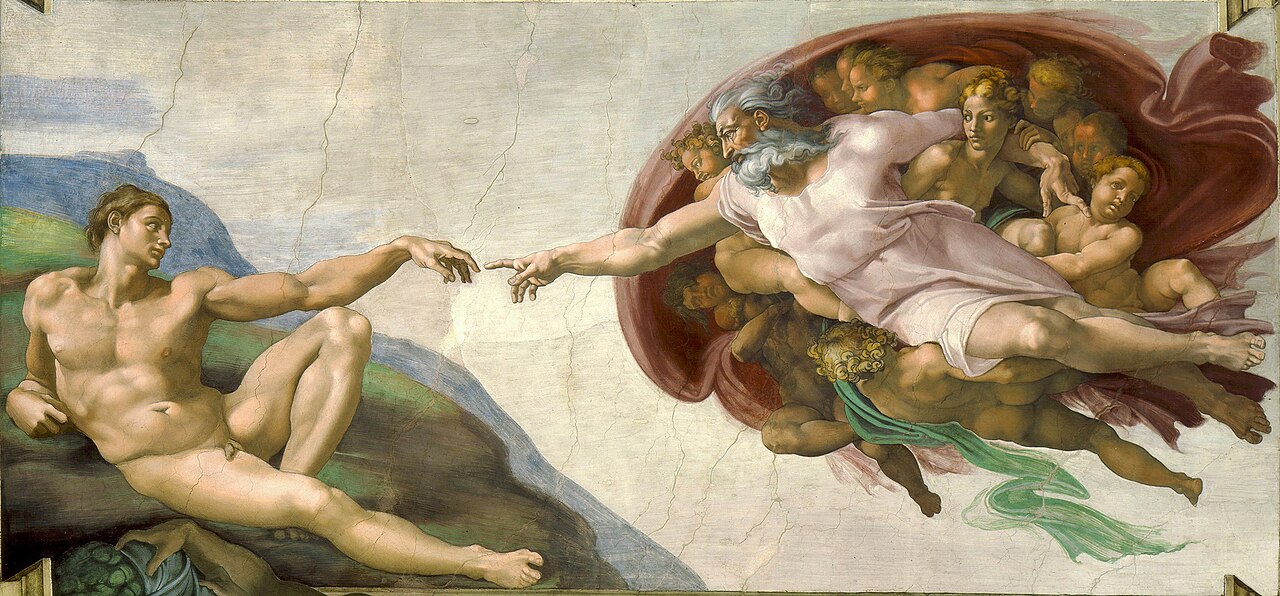
Source: Wikimedia Commons. Public domain.
"...every religion in the world is based on fabrication. That is the precise definition of faith — the acceptance of what we imagine to be true but cannot prove. Every religion describes God through metaphor, allegory and exaggeration, from ancient Egypt to Sunday-school classes at the local church. Metaphors help our minds process the unprocessable. The problem arises when we begin to believe literally in our own metaphors" (...)
Should we sound the alarm and tell Buddhists that we have proof that Buddha did not emerge from a lotus flower? Or that Jesus was not born of a virgin in the literal sense of the word? Those who truly understand their religions know that these stories are metaphorical."
The Da Vinci Code
I am a child of Earth and of starry Heaven; but my race is of Heaven, know this well
Inscription on a Pythagorean-Orphic funerary tablet found in Rome. 1st century.
The chapters that make up the narratives of Genesis (historically elaborated probably after the Exodus) syncretize, with a monotheistic intent, the various mythic nuclei present among the Mesopotamian peoples who preceded the ancient Hebrews. It can be observed that from chapter XII onward, the biblical narrative acquires a more conceptual character and a kind of family history begins. The journeys of Abraham and his encounters with Yahweh constitute a period whose memory was passed down from parents to children through oral tradition.
Nevertheless, the concrete history of the people of Israel begins with the Exodus, when the decisive figure of Moses appears — a history whose poetic essence symbolizes and signifies far more than what it states in a linear reading.
The traditions invoked by the Hebrew sacred books belong to the common heritage of the first organized groups that inhabited the region. It is reasonable to speculate that these are merely reworked fragments of a far vaster and more complex original. In this way, that conception of an abstract and supreme creative power that manifests itself spontaneously to humankind is superimposed upon the presence of other gods, where multiplicity becomes evident.
At first glance, the literal interpretation of sacred texts may be regarded as a clear anachronism. Nevertheless, the historical interpretation of mythic narratives is a common occurrence. Evidently, many accounts may contain some element generated by concrete events that took place in the real world, which does not preclude the addition of other kinds of metaphorical meanings. But in the specific case of creationist narratives, the linear interpretation of events amounts to more than an obstinate dogma of faith — it is a denial of the scientific achievements of all humanity.
As early as the fourth century, Augustine, when explaining the opening chapters of the Genesis narrative, opposed the literal interpretation, replacing the historical style with another equally historical approach but employing poetic stylistic devices: metaphors and allegories:
It would be too naïve to assert that God formed man from the mud of the earth, shaping him with his fingers. Had Holy Scripture expressed such a thing, we should believe that the sacred writer had made use of a metaphor, and not imagine a God limited by organs such as our own." Saint Augustine